

Wind, solar, and hydroelectric continue to weave into Canada’s energy infrastructure, a market traditionally dominated by oil & gas
Wind, solar, and hydroelectric continue to weave into Canada’s energy infrastructure, a market traditionally dominated by oil & gas
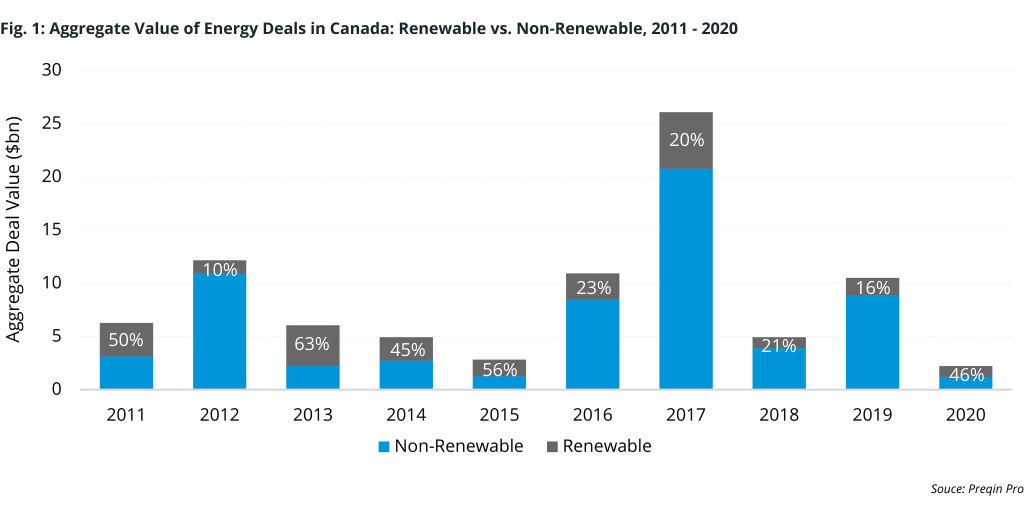
Energy is a large part of the Canadian economy. Over the past 25 years, the energy sector has contributed on average 9.6% to the national GDP, while producing nearly one-quarter of the country’s greenhouse gas emissions. But non-renewable sources are facing political headwinds, most notably the potential for the liberal-leaning government to impose carbon taxes. Of course, renewables have a long way to go to reach parity – the country’s vast resources spread across large, sparsely populated areas have made the business of non-renewable resources extremely lucrative – but data from 2020 in particular shows renewables are gaining ground.
With concerns over global warming growing, Justin Trudeau’s government signed the Paris Climate Agreement in 2015, pledging to cut greenhouse gas emissions and to reduce dependence on fossil fuels. The Trudeau Government followed up with a climate change report in 2018, proposing carbon taxes, the phasing out of coal, and clean fuel standards.
This initiative created a conflict of interest for the state, which at the time was experiencing a boom in oil & gas investment, particularly in the oil sand fields of Alberta. However, like a snake eating its tail, the ramp-up in production and extraction led to a rush of global supply that compressed prices, rendering these investments less attractive. As Fig. 1 shows, this is borne out in the data. In fact, renewables accounted for 46% of total energy infrastructure investment in 2020, a huge increase from 16% on a larger amount in 2019, and a rebound to levels last seen before the oil sands boom.
Indeed, clean energy infrastructure has seen a steady stream of private capital investment over the past decade. Since 2011, $24bn in clean energy infrastructure deals have closed in Canada. This is much less than non-renewables’ $63bn, but still commensurate with the amount of energy produced by each method. Data from 2018 shows that 16% of the energy consumed in Canada was from renewable sources.
Wind power has been the dominant asset in clean energy, with about $11bn invested over the past 10 years. This is despite interest in the space waning recently, and wind power accounting for only about 5% of Canada’s total energy production. Preqin data shows five wind-power-related deals closing in 2020, although transaction values were not disclosed. So far in 2021, 10 deals have closed, again with limited visibility into the sum of assets behind them.
Montreal-based Axium Infrastructure has been one of the most active managers in the Canadian renewables space. The firm has been involved in 68 deals since 2012, most of which have been investments in solar and wind power. So far this year, Axium has acquired six renewable energy assets from CPP Investment Board, four of which are wind power farms, and the remaining two are solar power facilities.
For as long as climate change remains a backdrop for the world’s power needs, the Canadian energy landscape will be one to watch for investors. The country’s progression from non-renewables powerhouse to renewables hub is already underway, with about 16% of its energy needs supplied by non-fossil-fuel sources. But while this figure is above global averages, it leaves much to be desired. Given Canada has a long tradition of mining and oil & gas, the question remains: will the move to green energy be a sustainable one?